
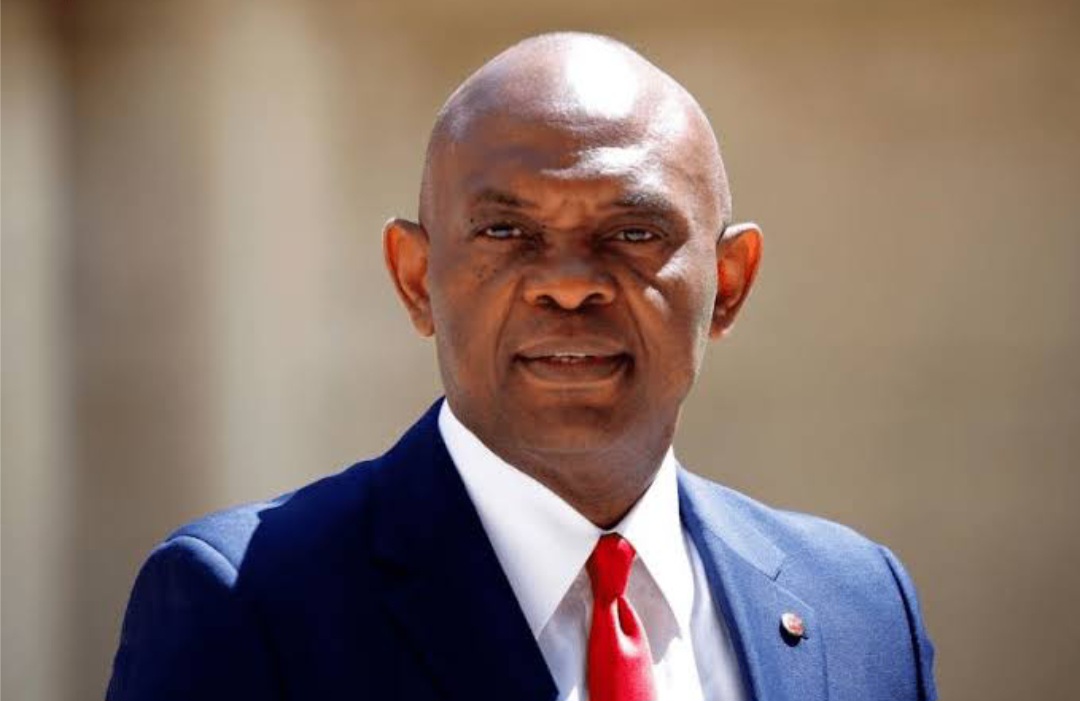
Writing about Tony Elumelu has always felt, to me, like a private reckoning disguised as public prose. I do not approach his story as a distant chronicler might, armed with sterile facts and perfunctory admiration. No. Each time I sit with the weight of his journey, I find myself implicated, drawn into a deeper contemplation of what it means for one man to bend the arc of a continent’s possibilities without noise, without theatrics, yet with a force so steady it becomes undeniable.
Some men accumulate wealth, and there are those rarer beings who generate motion; living currents that surge through economies and imaginations alike. Tony belongs, unquestionably, to that rarified order. I have watched, sometimes from the polished margins of society gatherings, sometimes from the more contemplative solitude of my own reflections, as his name travels effortlessly, and almost conspiratorially, through boardrooms, presidential villas, and conversations of ambitious young Africans. Wherever his name settles, something stirs. A quiet but insistent belief that perhaps, just perhaps, Africa needs not wait for permission to rise.
To celebrate him, therefore, is not merely to indulge in society-page flattery or the ritual of penning birthday tributes. It is to trace the trajectory of a life that has, with deliberate precision, rearranged the emotional and economic vocabulary of a people long accustomed to deferral. It is to admit, quite personally, how profoundly my own sense of possibility has been altered simply by observing him.
I must confess: I know him through the residue of his actions, through the testimonies of those whose lives he has disrupted in the most constructive sense, through the quiet revolutions he has seeded across a continent that has known too many false dawns. In that sense, acquaintance becomes influence, and influence, in his case, becomes something close to presence.
I remember vividly the moment news filtered through the social circuits about his honour in the US by TIME100. It was one of those stories that society thrives on: the convergence of power, prestige, and symbolism. Interestingly, Tony, and his wife, Awele Elumelu, were named among the TIME100 philanthropists for 2026. According to TIME, the list of top philanthropists for this year was finalised to recognise 100 individuals, representing the most compelling stories in philanthropy today, in a field that moves more than $1 trillion globally each year.
“By telling stories about the world’s most influential givers, leaders, advocates and thinkers, we hope to inspire others to give, and to consider the profound impact that this field has on our future,” TIME added.
The TIME100 Philanthropy initiative spotlights the world’s most influential leaders, activists and donors transforming the future of charitable giving.
The initiative was launched as a new annual franchise in 2025, highlighting how philanthropy was evolving toward collaborative and community-driven models to address urgent global challenges.
Now, I have witnessed honours bestowed before. I have seen medals pinned, titles announced, applause orchestrated. But this felt different, even from afar. It did not read like mere ceremony; it resonated like recognition earned in the quiet, unglamorous trenches of sustained impact. It was Africa, in one of its rare moments of coherence, turning to one of its own and saying: We see you.
Yet what struck me most, as I replayed the scene in my mind, was not the honour itself but the man receiving it. Tony did not appear, even in that grand moment, as a solitary figure basking in deserved glory. He seemed, rather, like a conduit, bearing, almost solemnly, the aggregated aspirations of millions. That distinction matters. Because in Tony’s story, the celebration of the individual is inseparable from the validation of an idea.
And that idea, as we have all come to know, sometimes through admiration, sometimes through scepticism, that eventually dissolves is Africapitalism.
I have heard many men articulate doctrines. It is, after all, fashionable in elite circles to speak in frameworks, to coin philosophies that sound compelling over cocktails and conferences. But how many embody what they preach? How many collapse the distance between rhetoric and reality? In Tony Elumelu, I have observed a rare coherence. His philosophy does not float above his actions; it breathes through them.
Just recently, in Abuja, in a room thick with anticipation and the usual society mix of policymakers, development partners, and the ambitious, Tony unveiled a fresh cohort of 3,200 young African entrepreneurs drawn from 54 countries, each armed with $5,000 in seed capital and something far more potent: validation. I watched him speak, not with the distant authority of a benefactor dispensing largesse, but with the deliberate urgency of a man who understands the stakes. “This selection was purely by merit and not by quota,” he said. Then he leaned into a detail that electrified the room: “Across thousands of applications, women stood out, through the strength of their ideas, the clarity of their business models and the ambition of their vision… when opportunity is accessible, African women do not simply participate—they lead.”
Through the Tony Elumelu Foundation, Tony funds businesses and democratises access to possibilities. The selected entrepreneurs will receive capital, mentorship and entry into TEFConnect, a digital ecosystem that binds thousands of African dreamers into a community of practice. He spoke of systems, shared prosperity, and the moral urgency of job creation. “It is not about the money in our bank accounts, but about the impact we make,” he insisted, before delivering what felt like both a warning and a vow: “It would be a great betrayal of Africa’s youth if we fail to do so.” In that moment, I understood why his interventions resonate so deeply.
Through Heirs Holdings, he has constructed not just a business empire but a deliberate intervention into Africa’s structural inertia. Energy, hospitality, healthcare, finance, these are not random sectors of conquest. They are carefully chosen pressure points, each investment a calculated incision into the stubborn anatomy of underdevelopment. I have often found myself studying this pattern, almost like a social cartographer, tracing how influence expands not by accident but by intention.
And then there is United Bank for Africa (UBA), as it is more familiarly invoked in both elite and everyday conversations. I have watched its evolution with a mixture of professional curiosity and personal intrigue. What was once another bank in a crowded financial landscape has, under his stewardship, become something far more expansive. A bridge. A network. A statement.
When I encounter traders in Accra, entrepreneurs in Abidjan, or even the restless, idea-rich youth of Lagos, I often notice how seamlessly UBA threads through their aspirations. It is not just a financial institution; it is an enabler of motion. And in its unmistakable scarlet identity, one senses something deeper than branding; one senses ambition, continental in scope and unapologetic in its reach.
But if I am to be entirely honest, and this is, after all, a personal reflection, it is not his corporate conquests that move me most. It is what he has chosen to do with the power those conquests confer.
Through the Tony Elumelu Foundation, I have seen a different dimension of him emerge, one that feels less guarded, more revealing. Here, the language shifts. It is no longer about balance sheets or expansion strategies; it is about belief. About beginnings.
We often speak, rather casually, of numbers: 18,500 entrepreneurs empowered, over a million Africans digitally connected, more than $100 million disbursed. These figures circulate easily in media reports and conference speeches, impressive in their scale but somehow inadequate in capturing the emotional gravity of what they represent. Because behind each number is a story I have either encountered directly or absorbed through the social bloodstream, a young woman in Kaduna daring to build, a young man in Kinshasa refusing the seduction of migration because he has, finally, something to stay for.
These surpass random statistics to me; they connote salvation.
And as I reflect on this, I find myself arriving at a conclusion that feels both obvious and profound: Tony’s genius lies not merely in building systems, but in restoring faith. In a continent where hope has often been treated as an inaccessible commodity, he has made it accessible and very practical.
There is something subtly rebellious in this. For as long as I can remember, Africa has been narrated, often by outsiders, sometimes by ourselves, as a continent in waiting. Waiting for aid. Waiting for validation. Waiting for solutions imported from elsewhere. Tony rejects this script with a calm but unmistakable defiance. Through every investment, initiative, and carefully curated intervention, he asserts that Africa’s future will not be delivered; it will be designed.
And I must admit, this insistence has influenced how I see things: how I write, how I interpret the movements of power and possibility across our society. It has reinvigorated my expectations.
When I consider his journey, I am struck not just by its scale, which is, undeniably, vast, but by its intentionality. Nothing feels accidental. From the audacious consolidation that reshaped UBA into its modern form, to its expansion across more than twenty African countries and into global financial capitals, there is a discernible logic at work. A refusal to be confined. A quiet but relentless pursuit of relevance.
Yet for all this, what continues to intrigue me, what keeps drawing me back to his story, is the man himself. Because beyond the boardrooms and policy circles, beyond the accolades and carefully staged photographs, there is a human presence that feels remarkably grounded.
I have observed, with no small fascination, how comfortably he navigates the highest corridors of power while remaining attentive to the faintest murmurs from the grassroots. He can engage presidents with ease, yet listen—genuinely listen—to the untested ideas of young entrepreneurs whose only currency is conviction. That duality is not common.
Perhaps that is why his influence feels so expansive. He is not distant from the people he impacts; he is, in many ways, an extension of their aspirations.
I recall the description offered in Libreville, how President Nguema spoke of him not merely as a visionary entrepreneur but as a committed friend of Gabon. I found that choice of word, friend, particularly striking. In our world, where relationships between capital and countries are often transactional, even predatory, friendship suggests something else entirely. It suggests empathy. Shared destiny. A refusal to extract without also giving.
And this is where Tony’s approach reveals its most radical edge. He does not enter markets with the appetite of conquest; he arrives with the discipline of cultivation. He builds. He nurtures. He stays.
In an era where global capital often behaves like a transient visitor, arriving loudly, extracting quickly, departing quietly, his model feels almost subversive. He expands ecosystems rather than exploits them. He distributes opportunity rather than hoards advantage.
His battles, if one can call them that, are not fought through aggressive monopolies or theatrical takeovers. They unfold in quieter spaces, in mentorship sessions, investment deliberations, the slow, patient construction of institutions designed to outlive him. And his victories are measured not in dominance, but in distribution. In how widely opportunity travels. In how deeply impact is felt.
Yet even this does not fully capture the essence of the man. Because beyond the empire, beyond the philosophy, there exists a more intimate dimension, one that I find particularly revealing.
In his marriage to Awele Elumelu, I have glimpsed a different kind of leadership. One that operates not in public declarations but in private gestures. The story of the marathon medal, for instance, lingered with me far longer than I expected. The image of Tony retrieving that medal and placing it gently around Awele’s neck, it may seem, at first glance, like a simple act of affection. But I read it differently.
To me, it was an extension of his broader philosophy. A refusal to let effort go unrecognised. A commitment to honour even the smallest victories. In that moment, the empire builder receded, and the attentive partner emerged. And somehow, the two felt inseparable.
That, perhaps, is the most compelling thing about him. The consistency.
He does not relapse into public brilliance and private absence. He remains, in essence, the same. He is attentive, intentional, and relentlessly invested in the people and possibilities around him.
And so, as I sit with the full arc of his journey, I find myself returning to a singular insight: that his greatest contribution may not be the institutions he has built, impressive as they are, but the imagination he has inspired.
Because in a place where limitation has often been internalised, he has proposed—no, demonstrated—a different narrative. One in which Africans are not peripheral to global prosperity, but central to it. One in which wealth is not an end, but a means. One in which success is measured not by accumulation, but by elevation.
This is the moral bent of Africapitalism as I have come to understand it, not merely an economic framework, but a proposition about how power should behave: onscientiously and accountably.
And in living this philosophy so visibly, so consistently, Tony Elumelu has become, for many of us, something more than a businessman. He has become a symbol. A living argument that capitalism, in African hands, can be both profitable and principled.
How does one quantify the restoration of hope? How does one measure the dignity returned to individuals who had long been told, explicitly or otherwise, that their dreams were excessive? How does one account for the quiet revolutions that occur when a young entrepreneur is told, perhaps for the first time: You are enough?
I do not think it can be done. Not in numbers and citations. Not even in the most eloquent prose.
And so, what remains for me is this: a confession.
A confession that in observing Tony Elumelu’s journey, I have been forced to reconsider my own assumptions about power, possibility, and the responsibilities that accompany influence. A confession that admiration, in this case, is inseparable from gratitude.
Because in a world that often rewards noise over substance and spectacle over sincerity, he has chosen a different path. And in doing so, he has altered the destinies of many; he has altered, in ways both subtle and profound, the way some of us see the world.
Interestingly, the arithmetic of his ascent of the ladder of success is absolute, like the third movement of Beethoven’s Minor Quartet. His fortune has often been adduced to his sweet patronage by fate. But that is simply one way to look at his lot. If he hadn’t shed sweat via honest labour, providence wouldn’t have graced his porch.
Watching Elumelu play the part of a father to his wards validates the loftiest notions of fatherhood: that the heart of a father is a masterpiece of nature.
Some would call it the earthly root of all benevolence and wisdom. For some, it subsists as the hearth of parental love and care, priceless for the warmth it gives, and its luminous flare of compassion.
The depth of Elumelu’s love for his children is matchless, and the reason is not farfetched. Very early in life, the UBA Chairman laboured to situate fatherhood at the core of his universe. Thus, whether within or outside the confines of the boardroom, Elumelu adorns fatherhood like an expensive cloak, taking ultimate care of every fibre and strand of its priceless habiliment.
He is, in every sense, unlike the proverbial father who evades the prickly and glosses over the painful. He is not the kind of father that teases and deceives. He neither toys with his children nor subjects them to bitter, manifold sarcasm when–as is always the case–sarcasm is the last thing they need.
He is not the kind of father with pretension to knowledge he doesn’t possess; he is not the type of father that tries to impose wisdom on his wards with implacable gratuitousness. Elumelu is a far cry from a walking cliché.
If you ask, he would tell you that a father’s presence in the life of his child is a priceless gift, that holds more value in the child’s life than any presents he might present to the child.
Elumelu understands that a father’s love for his kids is not bound by his expensive gifts to them but by his relationship with them. Thus, while he builds a titanic enterprise and an enviable dynasty to match, he painstakingly commits to sacrifices that establish him as the shine in his daughters’ eyes and the icons in his sons’ mirror.