● A warm encounter in Paris affirms billionaire’s stature as global power broker
● How his friendship with Macron boosts Nigeria’s industrial renaissance
Paris moves with a kind of measured elegance that feels older than history and lighter than air, a city where power flourishes along marble corridors and the world’s most consequential conversations often unfold far from the noise of spectacle. Beneath the polished ceilings of the Élysée Palace, seat of the French presidency and nerve centre of the Fifth Republic, such a moment arrived once again when Abdul Samad Rabiu, chairman of BUA Group and one of Africa’s most formidable industrialists, stepped through its stately doors to greet President Emmanuel Macron.
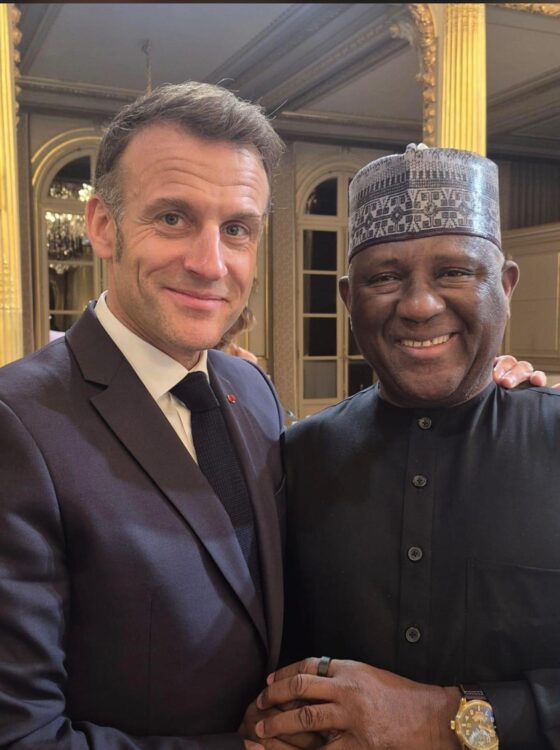
Photographs released afterwards captured the warmth of that meeting with an ease that rarely accompanies powerful encounters: two men smiling across a small gulf of polished wood, the handshake relaxed, the posture unforced, the moment illuminated by the soft Parisian light that drifted through the palace windows. Yet behind that quiet image lay a story that extends far beyond cordiality or ceremony. Rabiu’s presence at the Élysée bore the weight of a journey that began decades earlier in the trading houses of northern Nigeria and now echoes through boardrooms, factories, and infrastructure corridors stretching across Africa. His meeting with Macron revealed a friendship that has matured over time and a recognition of Rabiu’s growing stature within the global architecture of industry.
Rabiu himself spoke with characteristic restraint afterwards, choosing words that carried warmth rather than theatrical flourish. Sharing an image from the meeting, he reflected upon the encounter with a tone that suggested familiarity rather than novelty.
“A pleasure to meet again with President Emmanuel Macron at the Élysée Palace in the City of Light,” he wrote. “I truly value our friendship and his inspiring leadership.”
Within those few lines resides a narrative of exquisite diplomacy and mutual regard. Business leaders rarely move within the intimate orbit of heads of state without the gravitational pull of influence, and Rabiu’s relationship with Macron stands as evidence of a rare convergence between enterprise and statesmanship. Such meetings do not unfold merely because a businessman commands wealth. They arise when a figure’s ideas, investments, and influence begin to shape the broader landscape of nations.
Rabiu’s journey toward that sphere of influence has been neither theatrical nor abrupt. Patience marks his rise, the patience of a builder who believes in foundations that endure long after applause fades. Cement factories, sugar refineries, flour mills, ports, power plants and mining ventures emerged gradually across Nigeria under the banner of BUA Group, each project anchored by a conviction that industrial capacity forms the backbone of national sovereignty. Factories produce more than commodities; they forge independence, create employment, and generate the infrastructure through which societies sustain themselves.
Such philosophy has guided Rabiu for decades, yet recent years have witnessed a dramatic acceleration in both his fortunes and his visibility upon the world stage. Financial data released this year confirmed that his wealth surged with remarkable velocity, placing him among the most significant beneficiaries of Africa’s current industrial expansion. Net worth estimates climbed sharply, rising to approximately $11.2 billion and propelling him into the upper ranks of the continent’s wealthiest figures.
Observers of global finance traced much of that ascent to the extraordinary performance of BUA Cement, the publicly listed powerhouse that has become one of Nigeria’s most influential industrial enterprises. Share prices soared by roughly 135 percent within a single year, an achievement that towered above the broader movements of the Nigerian stock market. Investor confidence swelled around the company’s expanding production capacity and its ambitious plan to deepen Nigeria’s cement independence while exporting strength across West Africa.
Numbers, however impressive, tell only part of the story. The surge in BUA Cement’s valuation signalled deeper currents within Nigeria’s economic life. Industrial capacity within the country has long struggled against a tide of imports, infrastructural limitations, and fluctuating policy environments. Rabiu’s strategy aimed to reverse that tide by committing enormous capital to domestic manufacturing and supply chains, thereby reducing dependence upon foreign production and strengthening Nigeria’s industrial spine.
Factories rose across landscapes once defined by silence, their chimneys releasing plumes that carried the scent of possibility. Cement plants expanded across multiple states, each facility operating as a small industrial ecosystem that generated employment, stimulated logistics networks, and drew ancillary industries into orbit. Trucks moved along highways loaded with the grey powder that builds cities, while investors watched the company’s performance with growing interest.
Such achievements naturally attracted international attention, and the meeting with Macron must be understood within that broader context. France remains one of Europe’s most influential economies, its companies deeply involved in infrastructure, energy, and manufacturing ventures across Africa. Dialogue between Rabiu and the French presidency therefore represents a convergence of interests at a moment when Africa’s industrial future is beginning to command renewed global interest.
Macron himself has pursued a deliberate strategy of strengthening economic partnerships with African nations, seeking collaboration that moves beyond traditional extractive models toward manufacturing, technology, and sustainable development. Rabiu’s vision aligns neatly with that ambition. Where many enterprises once focused on exporting raw materials, BUA Group concentrates upon refining those resources within Africa, transforming limestone into cement, sugarcane into refined sugar, wheat into flour and food products, and minerals into industrial inputs.
Such philosophy resonates with a broader shift unfolding across the continent. Africa’s demographic expansion promises a vast consumer market in coming decades, yet sustained prosperity requires industries capable of meeting that demand internally. Rabiu’s factories embody that ambition. They represent a belief that Africa’s prosperity must rise from production rather than dependence.
The Élysée meeting therefore acquired symbolic depth, presenting Rabiu as an ambassador of African industrial possibility. Conversations between leaders like Macron and entrepreneurs like Rabiu help shape the frameworks through which international investment flows into emerging markets. Diplomacy within such contexts often unfolds quietly, woven into discussions about infrastructure finance, trade partnerships, technology transfer, and environmental sustainability.
Prestige also flows from such encounters, though Rabiu himself rarely appears preoccupied with public displays of status. Within the rarefied circles of global industry, relationships with world leaders signal credibility and trust. They suggest that a business leader possesses the capacity to navigate the complexities of international policy, economics, and diplomacy. For Rabiu, whose enterprises already command enormous domestic influence, recognition from global statesmen strengthens the aura surrounding his industrial empire.
Prestige of that sort reverberates far beyond personal acclaim. Nigerian industry benefits whenever its leading figures command respect within global capitals. Investors study those signals carefully, interpreting them as indicators of stability and potential. Each handshake at the Élysée, each conversation within the palace’s ornate chambers, subtly reshapes perceptions of Nigeria’s industrial environment.
Nigeria’s economy has long balanced immense promise with persistent structural challenges. Oil wealth once dominated national discourse, yet volatility within global energy markets exposed the dangers of excessive dependence upon a single resource. Visionary industrialists therefore began searching for alternative engines of growth. Rabiu emerged among the most persistent voices advocating large-scale manufacturing as the pathway toward durable prosperity.
Factories within the BUA portfolio testify to that philosophy. Cement plants produce the raw material of urban expansion. Sugar refineries contribute to food security while reducing costly imports. Flour mills feed millions through bakery supply chains that stretch from bustling megacities to small roadside kiosks. Infrastructure investments, including port developments and logistics networks, strengthen the arteries through which commerce flows.
Each project unfolds with the quiet ambition of reshaping Nigeria’s economic architecture. Such vision requires enormous capital, disciplined management, and patience capable of enduring economic storms. Rabiu’s career has weathered currency fluctuations, regulatory shifts, and global financial turbulence. His resilience has become part of the mythology surrounding BUA Group.
Yet the story would remain incomplete without acknowledging another dimension of Rabiu’s public life. Wealth accumulated through enterprise often carries expectations of social responsibility, particularly within societies confronting developmental challenges. Rabiu addressed that responsibility through the creation of the ASR Africa Initiative, a philanthropic foundation that channels substantial resources into education, healthcare, and community development across the continent.
Universities, hospitals, and research institutions have received grants through the initiative, enabling projects that range from medical infrastructure to academic research facilities. Such interventions reflect Rabiu’s belief that economic transformation must travel alongside social investment. Industrial prosperity alone cannot sustain societies unless education, health, and opportunity expand alongside it.
The philanthropic dimension further enriches Rabiu’s global reputation. International leaders frequently regard philanthropic engagement as evidence of a business leader’s broader vision for society. Within conversations at the Élysée Palace, such reputation undoubtedly contributed to the warmth evident in Rabiu’s remarks about Macron’s leadership.
France itself maintains deep historical ties with Africa, ties that remain complex and occasionally contentious. Yet contemporary economic diplomacy increasingly seeks partnerships grounded in mutual development rather than colonial legacy. Entrepreneurs capable of articulating Africa’s industrial ambitions therefore occupy a crucial position within that evolving relationship.
Rabiu’s presence within Paris symbolised the emergence of a new generation of African industrialists who engage the world on equal footing. These figures approach global partnerships with confidence rooted in tangible achievements at home. Their factories operate across African landscapes, their companies trade upon international markets, and their philanthropic initiatives contribute to continental development.
Such credentials transform business leaders into informal diplomats. They carry the narrative of Africa’s transformation into conversations with presidents, ministers, and investors. Rabiu’s meeting with Macron offered a glimpse of that role in action. His words about friendship conveyed warmth, yet beneath the sentiment lay a recognition that economic relationships between continents increasingly rely upon individuals capable of bridging worlds.
Within Nigeria, Rabiu’s ascent continues to inspire fascination. The country’s elite circles watch his trajectory with keen interest, recognising that his rise reflects broader shifts within the nation’s economic hierarchy. Industrial wealth gradually rivals fortunes historically derived from oil concessions or government patronage. Manufacturing has begun reclaiming a place within Nigeria’s national imagination.
Factories once stood as symbols of post-independence aspiration, relics of an era when leaders believed industrial capacity would anchor national prosperity. Many of those dreams faded under the weight of economic crises and structural adjustments. Rabiu’s ventures revive echoes of that earlier ambition, proving that large-scale manufacturing can flourish again under disciplined leadership and strategic investment.
Such revival resonates beyond economics. Industrial employment fosters a sense of dignity among workers whose livelihoods depend upon steady wages rather than precarious informal labour. Communities surrounding factories often experience transformation through improved infrastructure, educational opportunities, and local commerce.
When Rabiu stood within the halls of the Élysée Palace, he carried those stories with him. Each handshake between global leaders and African industrialists represents countless workers whose daily labour animates factories across the continent. Diplomacy often speaks in abstractions, yet its consequences ripple through ordinary lives.