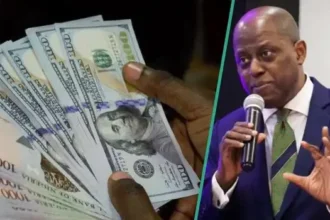
The Monetary Policy Committee of the Central Bank of Nigeria on Tuesday retained the Monetary Policy Rate, which is the benchmark lending rate, at the current 14 per cent.
The decision to leave the rate unchanged was contrary to expectations of economic analysts, manufacturers and some government officials.
Indeed, the Minister of Finance, Mrs. Kemi Adeosun, had on Monday said there was a need for the apex bank to lower interest rates so that the government could borrow domestically to boost the economy without increasing debt servicing costs.
But addressing journalists at the end of the two-day MPC meeting, which was held at the central bank headquarters in Abuja, the CBN Governor, Godwin Emefiele, said the apex bank decided to hold the lending rate in order to maintain its primary objective of price stability.
He also said the decision was unanimously agreed on by all the 10 members of the committee who attended the meeting.
Apart from the MPR, he said members of the committee also left the Cash Reserve Ratio and the Liquidity Ratio unchanged at 22.5 per cent and 30 per cent, respectively.
The MPC also called on the Federal Government to introduce tax incentives to stimulate activities and return the economy to the path of growth.
Emefiele said the Federal Government should toe the line of other developed countries such as the United States that adjusted its tax policy during the period of economic recession to stimulate consumer demand.
For instance, he said the government should consider reducing the tax burden on the low and middle-income earners, while increasing the rates payable by the rich.
He said, “In the United States and other economies, when you have situations like this, there are those who are naturally vulnerable – the weak, the low and middle-income people. What the government can do is to reduce their tax rates; and for the rich, increase their tax rates so that they can pay more, and this balances out.
“In fact, you can increase more for the high-income earners so that the disposable income for the poor and vulnerable, and middle-income earners can increase so that they can pump liquidity and use it to boost consumption spending.”
Emefiele said the MPC considered the numerous calls for rate reduction but came to the conclusion that the greatest challenge to the economy at the moment remained incomplete fiscal reforms, which raise costs, risks and uncertainty.
The CBN governor said the committee was of the view that in the past when the rates were reduced to achieve these objectives, it was later discovered that rather than deploy the available liquidity to provide credit to agriculture and manufacturing sectors, it provided opportunities for lending to traders who deployed the same liquidity in putting pressure on the foreign exchange market.
This, he lamented, resulted into limited supply of foreign exchange, thus pushing up the exchange rate.
He, however, lamented that the purpose for which the funds were deployed by the banks was not in line with the objective of the CBN.
He said, “Both the monetary and fiscal authorities all have the intention to achieve growth, but the direction through which we want to achieve it may differ for as long as you still achieve the growth.
“The issues here are that when you say reduce interest rates, there are two possibilities here. Firstly, you are saying that because you want it to spur credit to the private sector at lower rate. Secondly, which I have heard the fiscal authority talk about, is that they need to be able to borrow at lower rates to spend.
“Our own view at the MPC, which was exhaustively discussed, is that in the past, there was a time when the MPC took the decision to reduce the policy rate and the cash reserves. These were intended to lower rate and encourage spending to the private sector. After we did that, the following meeting we said because we did not see the impact of credit to the private sector that we needed to further reduce the CRR.”
Responding to a question that the decision to hold the benchmark interest rate was against the call by Adeosun to reduce it, the governor said that borrowing at lower rates to spend on consumption in an economy not backed by industrial capacity would further fuel inflation.
He said while the committee agreed that it was expected to stimulate growth through aggressive spending, doing so without corresponding efforts to boost industrial output by taking actions to deepen foreign exchange supply for raw materials would not help reduce unemployment.
Emefiele said, “The second part of it is that when you lower the interest rate, it will make it possible for the fiscal authorities to borrow at lower rates.
“But we are saying fine. If you borrow at lower rates to stimulate spending, what that does is that it simulate demand for goods, but when you stimulate demand for goods by providing cash or money to be spent without taking action to boost industrial capacity, manufacturing capacity and output, what happens is that you will see a situation where too much money will be chasing too few goods, which will worsen the inflationary conditions that we have now.
“And that is why we are saying that the option that we would like to adopt is while the fiscal authority is going ahead to spend, what we want to do is to retain the rates where they are so that that will again encourage the inflow of capital, because between July and now, we have seen the inflow of above $1bn.”
The governor also said that the CBN would continue to monitor the sale of forex to the BDCs, adding that any bank undermining the integrity of the foreign exchange market would be sanctioned in line with current guidelines.
LCCI DG reacts
While reacting to the outcome of the MPC meeting, the Director-General, Lagos Chamber of Commerce and Industry, Mr. Muda Yusuf, said it underlined the imperative of proper coordination between the monetary and fiscal authorities in the economy.
He said, “What is desirable at this time is to stimulate growth and create jobs. My view is that lower interest rates will benefit the economy more than it will hurt it. The truth is that the economy is afflicted by challenges of a multidimensional nature, rooted in structural weaknesses, tight monetary conditions, forex policy shortcomings, weak institutions and floundering investors’ confidence.
“Fixing the problems requires proper strategic responses from the fiscal, monetary and political governance fronts. And these response actions are not necessarily mutually exclusive. Indeed, they should be taken together. The economy surely has profound issues with infrastructure; but high cost of funds is also one of the major problems, which investors are worried about.
“There is a need at this point to agree on what the national economic objective should be. This is why I will agree with the proposition to have a retreat among the key actors in the fiscal, monetary and political governance space to agree on a common direction and strategy to rescue the economy.”
Recession will worsen – Experts
Economic and financial experts said the decision not to cut the lending rate would worsen the current recession.
A Senior Partner, Transaction Advisory Services, EY, Mr. Bisi Sanda, said, “Having recession and inflation together in any country usually creates a dilemma. But there is no need to start targeting inflation when Nigerians are suffering. We need to look at how we can boost growth and employment at the moment. That is what we need.”
The Chief Executive Officer, Financial Derivatives Limited, Mr. Bismarck Rewane, said, “They could have increased the interest rates, but they did not. So, they decided to adopt a wait-and-see attitude, which won’t help the recession. But it may forestall imbalances.
“However, there is an assumption that foreign funds will come in. Foreign funds are not going to come in if the external imbalances persist. If you think that people are going to bring in money and that will help the naira that is a bit of a very ambitious assumption. So, it is going to be a very slow and painful recovery.”
A professor of financial Economics at the University of Uyo, Akwa Ibom, Leo Ukpong, also opposed the MPC’s decision, saying, “That is not the best move; I would have expected them to cut the interest rate. The biggest problem we have is not inflation; it is putting people in the job market.
The Managing Director, Cowry Assets Management Limited, Mr. Johnson Chukwu, said, “There has to be some level of co-ordination between the monetary and fiscal authorities.”
According to him, the monetary authority headed by the CBN governor is pushing for price stability, while the fiscal authority led by the Finance minister seeks economic growth.
“My take is that restoring economic growth is more important than price stability,” Chukwu added.
However, the Head, Research and Investment Advisory, SCM Capital, Mr. Sewa Wusu, said if the CBN had danced to the tune of the Finance minister, the credibility of its monetary policy stand would be at risk given that it was at the last meeting that it raised the MPR by 200 basis points.
He said, “So, I think that is the reason why they had to balance the optimism by retaining the interest rate with the view that maintaining the status quo will most likely attract foreign inflows and then look at the fiscal side – aggressive fiscal policy in terms of spending – to boost domestic growth.
“I think the onus now lies on the government to ensure that they release more funds.”