
– Abiodun’s best kept secret revealed amid sweeping infrastructure drive
– The things President Tinubu saw in Ogun’s political, economic space
Power, at its most consequential, is not loud, it is enduring. It reveals itself in structures that stand where doubt once hovered. It persists through leadership that conquers limitation, driven by a temperament that treats impossibility as a dare.
Governor Dapo Abiodun has consistently governed from that rare altitude. Refusing to trim his aspirations to fit the narrow frame of precedent, he chose instead to expand the frame itself, stretching the very idea of what subnational governance can achieve.
His completion of the Gateway International Airport in Iperu is the most audacious expression of that governing will. Conceived in skepticism, pursued through seasons of doubt, and delivered in defiance of Nigeria’s long history of abandoned megaprojects, the airport stands today as proof of capacity. It is the signature of a governor who does not start what he cannot finish, and more importantly, does not abandon what he has begun.
For years, the Gateway International Agro-Cargo Airport existed in the uneasy space between vision and skepticism, a bold idea many believed would join Nigeria’s graveyard of abandoned ambitions. But Abiodun governed differently. He did not retreat before complexity, nor dilute the scale of his aspiration. Instead, he persisted until the airport dream was born. Today, with commercial passenger and cargo operations underway and the threshold of international flights within reach, the airport stands as an affirmation of Abiodun’s infrastructural drive and his uncommon governing will.
This is the essence of Abiodun’s legacy in motion: a refusal to concede to odds, a capacity to convert vision into verifiable reality, and a pattern of delivery that has steadily repositioned Ogun State from a geographical afterthought into a deliberate destination of growth.
Against fiscal constraints, institutional inertia, and the familiar chorus of cynicism that trails public ventures, Abiodun pressed on. He did not scale down the dream; rather, he scaled up the discipline required to realise it.
This is, however, not an isolated triumph. It is part of a larger governing pattern, one that has seen Ogun State acquire, under Abiodun’s watch, a succession of transformative “firsts”: world-class road networks, resuscitated port ambitions, expanding industrial ecosystems, and a coherent infrastructure logic that binds them all. Abiodun’s tenure has been defined by an unyielding insistence that Ogun must not remain a corridor state—merely a passage between Lagos and the hinterland—but must become a destination in its own right.
The airport tells that story with clarity. From its four-kilometre runway—one of the longest in West Africa—to its cargo terminals designed for agro-export, every inch of the facility speaks to intention. It is built not just to receive planes, but to dispatch prosperity. Farmers, manufacturers, and exporters now find themselves connected to global markets without the traditional bottlenecks of distance and delay.
Yet perhaps the most telling testament to Abiodun’s persistence lies in what comes next. In a landmark arrangement, Air Peace has committed to commence international operations from the Gateway Airport, with an inaugural direct flight to London, United Kingdom, scheduled for August 1, 2026. The process, already underway, involves the finalisation of international terminal certifications, customs and immigration full deployment, and the alignment of bilateral air service protocols. Aviation regulators, both domestic and international, are working in concert to ensure compliance, while ticketing frameworks and route scheduling are being synchronised ahead of the historic take-off.
That impending flight is more than a journey across continents; it is a symbolic crossing from aspiration to achievement.
It is also a vindication. For years, critics questioned the viability of the airport. They doubted its timing, its scale, and its necessity. But Abiodun pressed on, driven by a vision that understood infrastructure not as immediate gratification, but as generational investment. Today, the narrative has shifted. What was once dismissed now commands attention.
President Bola Ahmed Tinubu’s recent visit merely affirmed what had already become evident: Ogun’s transformation is neither accidental nor superficial. It is engineered. But the airport is only one chapter in a broader manuscript of defiance and delivery.
Across the state, Abiodun’s imprint is visible in a constellation of “firsts” that collectively redefine Ogun’s developmental identity. Roads stretch across economic corridors with new precision. Over 1,600 kilometres of roadway now bind communities to opportunity, collapsing distances that once stifled enterprise.
Then there is the long-gestating Olokola Deep Seaport, revived under his watch with renewed clarity of purpose. Conceived as a maritime gateway to complement the airport’s aerial reach, it promises to position Ogun as a logistics powerhouse, where sea, land, and air converge in economic synergy.
Housing estates rise where uncertainty once stood. Power projects hum with quiet reliability. Healthcare facilities extend dignity to the grassroots. Each initiative reflects a governing temperament unwilling to accept the ordinary.
This is the essence of Abiodun’s never-say-die approach: a refusal to govern within the limits of precedent. What emerges, therefore, is not merely a catalogue of projects, but a philosophy and canvas where ambition is allowed to fully express itself, and, more importantly, to be completed.
Completion. That is the operative word. For a people weary of abandoned sites and broken pledges, the sight of a finished airport—receiving flights, preparing for international routes, and catalysing economic activity—bears a profound psychological weight. It restores belief. It suggests that governance, when pursued with discipline and conviction, can still deliver.
And so, as the first London-bound aircraft prepares for its historic departure from Iperu, it will carry more than passengers and cargo. It will bear the imprint of persistence, the triumph of vision, and the urgent vindication of a governor who refused to stop halfway.
President Tinubu stepped into the narrative confronted by something rare in public life: visible, measurable, and deeply human progress. From the solemn weight of mourning in Plateau to the bright cadence of renewal in Ogun, the President’s recent journey to the state, traces the emotional arc of a nation suspended between pain and promise. Jos had offered him images of grief, a theatre of human loss that pressed heavily upon his spirit. Abeokuta and its surrounding corridors, however, provided a different register of construction, ambition, and order.
By the time his convoy rolled through Ogun State, one truth stood unassailable: Governor Dapo Abiodun had engineered a quiet revolution, and the President had come to witness it.
Abeokuta shimmered with anticipation long before the presidential jet cut through the sky. The mood possessed a rare electricity, drawn from gratitude as much as spectacle. Billboards rose across highways and intersections, heralding the President’s visit with bright declarations. Yet the deeper announcement came from the people themselves: artisans, traders, students, and young professionals who took to digital spaces with fervent pride. Images circulated with urgency: pristine hospital complexes awaiting unveiling, newly laid asphalt stretching into the horizon, and the skeletal majesty of an airport poised to alter economic destiny.
Markets stirred with anticipated profits as youths rehearsed chants and camera angles in equal measure. Civic pride acquired a festive rhythm. Ogun was ready to be seen. Such readiness did not emerge overnight. It had been forged through years of deliberate governance under Abiodun’s ISEYA mantra—an ethos that translated aspiration into action and policy into pavement. Roads became the first visible language of this transformation. Between January and February alone, the state unfurled a network of strategic arteries: Abeokuta–Obalende, Osinubi New Town in Ijebu-Ode, Sagamu–Ayepe, Afon Palace Road in Imeko, Lantoro–Oke-Yidi–Isale Ake Junction, and the extended Imashayi–Igan-Okoto–Ayetoro corridor. Each project reflected a philosophy grounded in connectivity, economic logic, and community consultation.
These were not random constructions. They followed the pulse of commerce, linking farms to markets, towns to industrial clusters, and hinterlands to opportunity. Residents recognized their own voices in the selection of these projects. Governance, in this instance, had listened before it built. President Tinubu encountered this network not as an abstract briefing but as lived reality. His convoy traced these routes, each stretch of asphalt offering a narrative of access restored and dignity reclaimed. His reaction carried the unmistakable imprint of surprise layered upon satisfaction. Ogun had exceeded expectation.
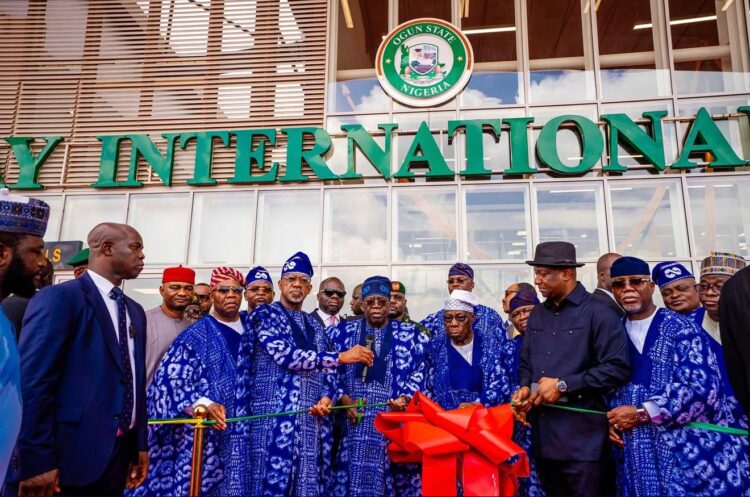
The centrepiece of the visit, however, lay in Iperu, where ambition had taken flight, literally and symbolically. The Gateway International Agro-Cargo Airport stood as a monument to foresight, its expansive runway stretching four kilometres into possibility. Control towers pierced the skyline with quiet authority. Cargo terminals hinted at future streams of trade, linking Ogun’s agricultural wealth to global markets.
Crowds surged around the facility, filling every available space with colour and anticipation. Political leaders, industrial titans, and traditional power brokers assembled in a convergence that mirrored the airport’s own promise of connection. The Senate President, governors from across the federation, elder statesmen, captains of industry, each presence added weight to the moment.
President Tinubu stepped into this arena with visible curiosity. By the time he mounted the podium, curiosity had given way to conviction. His words carried both clarity and warmth. He spoke of vision realized through discipline, of leadership anchored in tangible outcomes. He praised Abiodun’s stewardship with a candour that resonated far beyond ceremonial politeness. Ogun’s progress, he affirmed, offered a template worthy of national attention.
The airport’s design amplified this impression. Powered independently, integrated with logistics frameworks, and conceived as an aerotropolis, it represented a comprehensive approach to development. Trade, transportation, and urban planning converged within its architecture. Such coherence rarely appears by accident.
Alongside the airport came the unveiling of Gateway Airline, its Bombardier CRJ 900 aircraft gleaming with the promise of mobility and economic expansion. Aviation, long perceived as an elite domain, now aligned with regional growth strategies. Ogun positioned itself as a hub rather than a bystander.
Tinubu’s enthusiasm found further expression in the commissioning of the Nigeria Customs Service hub, a sprawling N73 billion complex equipped with residential facilities, training institutions, warehouses, and healthcare infrastructure. This was governance that understood the interplay between security, commerce, and welfare.
Each unveiling reinforced a central theme: development must be practical, visible, and inclusive. Governor Abiodun’s address reflected this philosophy with measured confidence. He traced Ogun’s trajectory through numbers that carried their own eloquence. Internally generated revenue had surged from N40 billion to N250 billion. Gross domestic product expanded from N4 trillion to N17 trillion within seven years. These figures highlighted disciplined fiscal management and an economy awakening to its own potential.
Infrastructure served as both catalyst and consequence of this growth. Over 1,600 kilometres of roads now crisscrossed the state, linking industrial zones, residential communities, and commercial centres with newfound efficiency. Strategic corridors such as the Epe–Ijebu-Ode Expressway and the Sagamu–Papalanto route redefined movement across regions.
Housing initiatives complemented this expansion. Thousands of affordable homes rose across Ogun, offering dignity and stability to families long constrained by scarcity. The Muhammadu Buhari Estate added a distinct signature to this effort, blending accessibility with modern design. Healthcare witnessed a similar renaissance. Primary health centres multiplied across localities, ensuring that care reached the grassroots. The Gateway Medical Centre of Excellence introduced a higher tier of medical service, reducing dependence on distant facilities.
Energy infrastructure anchored these achievements. The Onijanganjangan Independent Power Project delivered consistent electricity, a critical enabler of industrial and domestic life. Agriculture benefited from mechanisation through modern tractors, enhancing productivity and food security.
Security, often the silent foundation of progress, received deliberate attention. Vehicles and operational support strengthened law enforcement agencies, creating an environment where enterprise could flourish without fear.
President Tinubu listened, observed, and absorbed. His reflections, later shared with characteristic directness, distilled the essence of his experience. Ogun, he noted, embodied the principle that development must touch every level of society. Progress revealed itself in concrete forms: aircraft, roads, energy systems, and human opportunities intertwined.
He acknowledged the role of federal reforms in enabling such outcomes. Increased allocations to states, driven by policy recalibration, had expanded fiscal space. Ogun’s example demonstrated how such resources could be translated into enduring assets. Yet his praise extended beyond policy frameworks and settled firmly on Abiodun’s leadership; Mr President praised the governor’s consistency, focus, and refusal to be distracted by politics.
The symbolism of the visit deepened as the President concluded his engagements. His final words carried the cadence of conviction: a full heart, a renewed sense of possibility, and a clear endorsement of the path charted by Ogun’s leadership.
He said, “I returned to Ogun State today with a full heart. What I saw in Iperu is the kind of progress we must insist on as a nation. Quite deliberate, and built to last. The Gateway Cargo Airport stands as proof of what is possible when vision is matched with discipline.
“Our investment is about our people. Today’s foundation is for tomorrow’s prosperity. I acknowledge Governor Dapo Abiodun for his focus and consistency. Development is not about noise. It is about decisions that improve lives.
“From the aircraft launched today to the electric bikes, tractors, and security assets, this is what progress should look like. Practical, real, and visible. Development must touch every level, and I am pleased to see that principle taking shape in Ogun State. We are building for people, and we are building for prosperity. As they say in Ogun, ‘Ìṣẹ́ yá.’ I say, ‘Ìṣẹ̀ ń lọ.’ The work continues.”
Such endorsement carries weight in a nation where rhetoric often outruns reality. In Ogun, reality certainly spoke for itself.